
- The reality of the New Jersey market
- The hyper local context problem
- The Problem With Relying on Review Volume Alone
- Treating your Google Business Profile like a social channel
- Technical foundations for 2026
- The zero volume search secret
- Local link building
- FAQs for NJ business owners
- Stop guessing and start converting
- Book Your Free Call Today
Local SEO Best Practices: How NJ Businesses Outrank & Outconvert
By:
Published:
Updated:
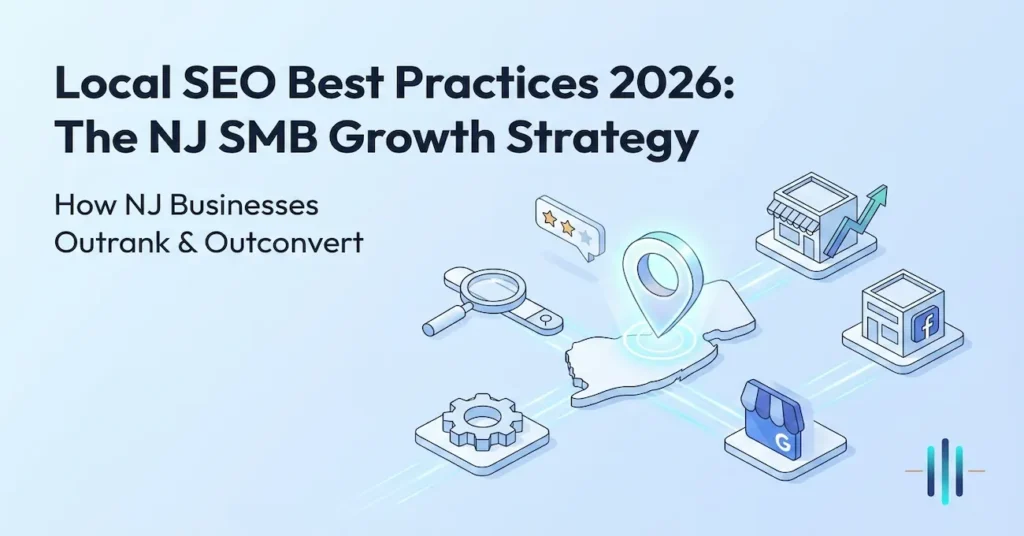
Ranking in the Map Pack is useless if your website doesn’t convert clicks into bookings. In 2026, local SEO is won by technical resilience, treating your Google Business Profile as an active social channel, and leaning into hyper local neighborhood strategies that outperform national competitors.
The reality of the New Jersey market
A lot of time I see agencies still sell basic directory listings as a growth strategy. They promise you visibility, but they ignore whether that visibility actually turns into revenue.
As a lifelong New Jersey resident, I know the Garden State is a densely packed, highly competitive market. There’s rarely a single plumber or boutique in a town. Instead, you’ll find ten of the exact same business models within a five mile radius, often fighting for space in the same shopping plazas.
Everything we do at Echo & Scale is always backed by data.
If you rely on a standard SEO checklist that just explains what you should have on your page to stand out, you’re going to lose to the competitor who understands that ranking is more than just what’s on the page. You have to make sure your site is also technically sound and you provide a conversion focused user first experience.
The hyper local context problem
It’s easy to throw “New Jersey” into your page titles. But a business in Jersey City has a fundamentally different audience than a business in Freehold Township.
Jersey City is urban, fast paced, and heavily influenced by the commuter lifestyle. Proximity to transit and immediate availability are the primary conversion drivers in a city like this. Whereas Freehold Township is suburban, family oriented, and reliant on driving everywhere. Very different areas, means very different people with very different problems. Which also means different SEO strategies.
| Environment | Example City | The User’s Problem | What Actually Converts Them |
|---|---|---|---|
| High Density Urban | Jersey City | Needs it right now, likely commuting | Mobile speed, “Open Now” status, proximity |
| Suburban Spread | Freehold | Planning ahead, willing to drive 15 mins | Trust signals, detailed case studies, reviews |
That’s why I think there’s a trade off between chasing broad statewide terms and focusing on specific neighborhood problems. While I like the idea of capturing traffic across the state, I’m not a fan of ignoring local nuance because those broad clicks rarely convert.
So for example, if you create neighborhood specific content that proves you operate in these communities, mention local landmarks, or address specific township regulations, you build immediate trust that resonates with your audience. Doing that should help inform your entire content strategy. When you build hyper local relevance, you stop competing with the entire state and start dominating your specific zip code.
The Problem With Relying on Review Volume Alone
One of the biggest things I see are businesses that focus too much on review volume and not enough on the quality of their website. We often see businesses fall into the trap of thinking review volume is the only metric that matters. Reviews are definitely a massive ranking factor as Google has confirmed. They heavily influence the Map Pack. But they can’t save a broken foundation.
I’ve looked under the hood of businesses that ranked #2 in the Map Pack purely because they heavily relied on hundreds of five star reviews. But their actual website was a disaster. And I mean navigation menus running a Halloween pet costume contest in May, Google Maps embedded awkwardly in the main header, nine conflicting H1 tags, and zero structured data.
Sure, they may have had visibility.
But then you look at their analytics and see a very high bounce rate. The user experience was actively turning away potential customers.
When your technical SEO is that fragile, your rankings are entirely a matter of luck. If Google decides to release a new Core Update tomorrow, you can probably expect your rankings to tank because of a poor technical foundation. If you want those strong rankings to result in bookings, you need a full technical site audit to clean up the mess. You can see how we approach this technical groundwork on our New Jersey SEO Company service page.
Treating your Google Business Profile like a social channel
Your Google Business Profile is often the first and last interaction a customer has with your brand. Treating it like a static phone book listing is a massive mistake.
Instead, treat it like an organic social media channel.
Use the posts feature to share highly relevant content directly on the search results page. Post clinical tips, before and after case studies, or limited time offers. When a user clicks your Map Pack listing and immediately sees active, helpful content, the trust barrier drops instantly.
Additionally, seed your own Q&A section. Don’t wait for customers to ask questions. Add questions yourself to that section with the top 10 questions you get asked every week. This goes to show search engines that you’re an active entity. It provides verified facts that AI driven search engines can extract and use to recommend your business.
Technical foundations for 2026
You can’t build a high converting local presence on a slow, broken website.
Google no longer just reads text. It identifies entities. You need to use JSON-LD structured data to explicitly tell search engines exactly who you are, what you sell, and where you’re located. If you run a franchise or have multiple locations, you need to implement a Multi-location Schema framework to define unique entity IDs for every branch.
As search behavior is shifting toward AI overviews, you need to ensure your data is structured for bots to easily scrape and cite your website. We broke down exactly how to format your code for this in our guide on Using Schema for AI Visibility.
The zero volume search secret
In 2026, SEO has moved past search volume and are now prioritizing the users intent. Most local businesses want to rank for the highest volume keyword, like “Plumber NJ.” The issue is that the search intent for these types of terms aren’t clear.
Knowing this helps us understand why focusing on zero volume keywords are actually more profitable. A term like “emergency burst pipe repair Mercer County” might show zero searches a month in Ahrefs, SEMRush or Ubersuggest. But the person searching for that in Google or an AI chat has a problem they need to get solved now, and you can be that solution instantly. That’s a revenue driver, not a traffic metric.
Targeting high-intent, specific queries is the fastest way to see an ROI. You can read more about shifting away from search volume in our breakdown of Intent-Driven Keyword Research.
Local link building
A local backlink from the Freehold Chamber of Commerce or a sponsorship link from a local New Jersey youth soccer team is worth way more to your local rankings than twenty generic directory links.
Focus on building relationships within your actual community like sponsoring sports events, partner with noncompeting businesses for cross referrals, and ensure your citations are consistent across regional directories like NJ.com.
FAQs for NJ business owners
Stop guessing and start converting
If you’re tired of getting clicks that don’t turn into phone calls, the problem isn’t your market. It’s your foundation. We help small businesses across the tristate area fix the underlying issues that are holding their revenue back.
Reach out to discuss a free SEO audit or explore our NJ Web Design & Development solutions to start turning your local traffic into actual growth.
Book Your Free Call Today
Schedule your Free 20 minute call and get a marketing plan specifically tailored to you.