
- The Keyword Research Trap: Why High Volume Doesn't Mean High Value
- The 4 Types of Search Intent (With Examples at Every Funnel Stage)
- How to Conduct Intent-Driven Keyword Research: A 6-Step Framework
- How to Audit Your Existing Content for Intent Alignment
- Intent-Driven Keyword Research Tools
- Real-World Examples: Intent Mismatch vs. Intent Alignment
- Common Mistakes in Intent-Driven Keyword Research
- FAQs About Intent-Driven Keyword Research
- Book Your Free Call Today
Intent-Driven Keyword Research: Why Volume Is a Vanity Metric (And What to Do Instead)
By:
Published:
Updated:
Picture this: you ranked #2 for a keyword pulling 22,000 searches a month. Traffic went up. You were happy for about a week, until someone looked at the conversion data. Bounce rate: 84%. Revenue from that page: roughly nothing.
Sound familiar? It should. It’s one of the most common and quietly expensive mistakes in SEO.
The problem wasn’t the ranking. The problem was that the people searching that term weren’t looking for what the page was selling. You attracted a crowd. Just the wrong crowd.
This is what happens when keyword research starts with volume and stops there. Volume tells you how many people searched something. It says nothing about why they searched it and that “why” is the whole game.
The Keyword Research Trap: Why High Volume Doesn’t Mean High Value
Most keyword research tools default to sorting by monthly search volume. It’s a reasonable starting point, but it very quickly becomes a rabbit hole where the biggest numbers get the most attention, regardless of whether those searchers will ever buy anything, sign up for anything, or even stick around long enough to read the page.
Here’s the thing: high volume head terms, or the “fat head” of the keyword demand curve actually account for only about 10–15% of all searches. The rest? Longtail queries with lower individual volume but, collectively, far more traffic and far more specific intent.
Longtail keywords account for over 91% of all web searches, and they convert at a higher rate than broad head terms. That’s not a minor footnote. That’s a fairly significant argument for rethinking what “valuable” means when you’re building a keyword list.
The core issue is a confusion between relevance and intent alignment. A keyword can be genuinely relevant to your business and still be completely wrong for your page. “CRM software” is relevant if you sell CRM software. But the person typing that at 9am on a Tuesday might be a university student writing a research paper, a journalist sourcing an article, or a developer exploring options for a client. Maybe one in ten is actually in-market. Chasing that keyword with a product page is a lot of effort for very little return.
The distinction that matters: Relevance asks “is this keyword related to what we do?” Intent alignment asks “do the people searching this keyword want what our page offers them right now?”
The 4 Types of Search Intent (With Examples at Every Funnel Stage)
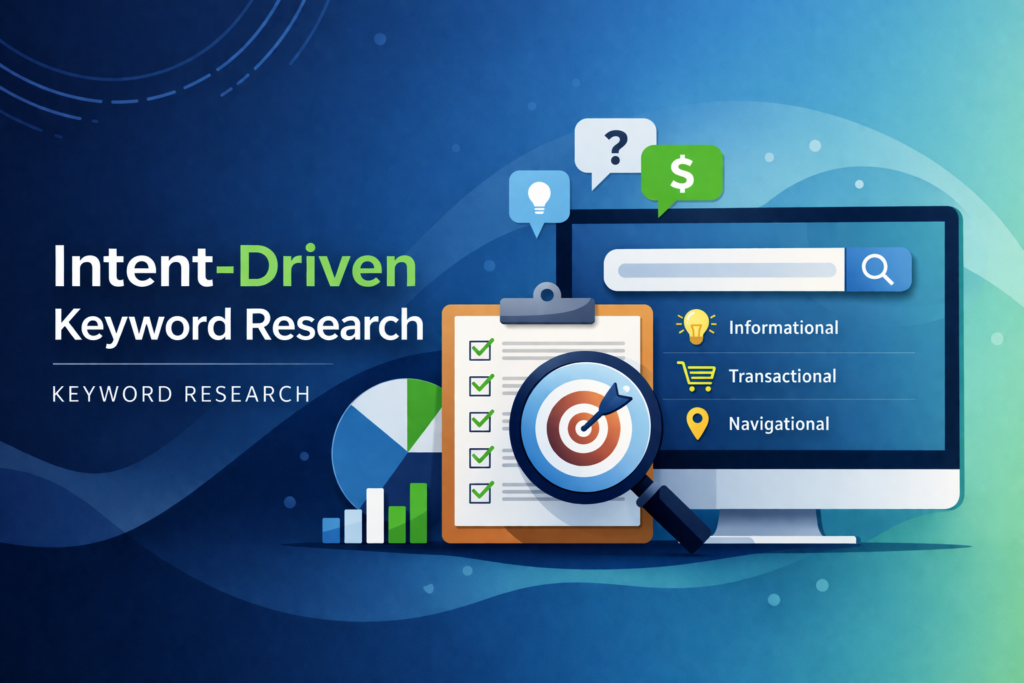
Before getting into the research process, it helps to have a clear working definition of the four intent categories. These aren’t abstract categories, they map directly to where a person is in their decision-making process.
| Intent Type | What users want | Funnel Stage | Signal Words | Best Content Format | Conversion Potential |
|---|---|---|---|---|---|
| Informational | Learn about a topic or concept | Top of Funnel | how, what, why, guide, tips, explained, tutorial | Blog post, FAQ, how-to guide | Low → Medium |
| Navigational | Find a specific website or brand | Any (branded) | [brand name], login, official, pricing, portal | Homepage, login page, brand landing page | Medium (already aware) |
| Commercial | Research and compare before deciding | Middle of Funnel | best, vs, review, compare, top, alternatives, worth it | Comparison guide, listicle, review article | High |
| Transactional | Ready to take a specific action | Bottom of Funnel | buy, price, free trial, download, sign up, near me, book | Product page, service page, landing page | Very High |
The practical difference between these two approaches compounds over time. Volume-first produces a lot of content that ranks reasonably well and converts poorly. Intent-first produces less content that ranks perhaps less dramatically but actually moves the needle on revenue.
How to Conduct Intent-Driven Keyword Research: A 6-Step Framework
Step 1: Start with the conversion endpoint, not the keyword tool
This is the step most people skip, and it’s the most important one.
Before you open Semrush, Ahrefs, or any other tool, ask what is the specific action you need a visitor to take on this page? Is it filling out a contact form? Starting a free trial? Booking a call? Adding a product to cart?
Once you know that, work backwards. What does a person search for immediately before they’re ready to take that action? Those are your highest-priority keywords. They have the shortest distance between “searches this term” and “does the thing you want them to do.”
This framing sometimes called “revenue distance” is useful. A transactional keyword has a revenue distance of roughly one step. An informational keyword might be five or ten steps away from a purchase. That doesn’t make informational keywords worthless, but it does change where you prioritize your resources and what you expect each piece of content to accomplish. It’s also the approach we use in our own client work, SEO strategy built around conversion intent rather than raw traffic volume.
Step 2: Build keyword clusters by intent type, not just topic
Keyword clustering is a standard SEO practice, but most people cluster by topic similarity. Intent-driven clustering goes a layer deeper: you group by topic and intent, because the same topic can require completely different pages depending on where the searcher is.
Take “email marketing” as an example. These three keywords are all about the same topic, but they need three different pages:
- “what is email marketing” → informational, wants an explainer blog post
- “best email marketing software for small business” → commercial investigation, wants a comparison guide
- “Mailchimp free trial” → transactional, wants a direct path to sign up
Putting all three on the same page is a common mistake. You’ll satisfy one group of searchers reasonably well and alienate the other two.
When building your clusters:
- Group keywords first by intent category
- Then group by topic within each category
- Each cluster = one page, with content and CTA calibrated to that intent
- Avoid mixing high-commercial and high-informational keywords on the same page if they pull in meaningfully different directions
Step 3: Validate intent with SERP analysis before writing a single word
This is the step that separates methodical intent research from guesswork and it’s surprisingly underused, even among experienced SEOs.
The idea is simple: Google has already figured out the dominant intent for most queries. The top-ranking pages reflect that. If you search a keyword and the top five results are all product pages, Google has determined this is a transactional query. If they’re all how-to guides, it’s informational. You don’t need to guess.
A practical SERP validation process:
- Search the target keyword in an incognito window (to avoid personalisation)
- Note the dominant content type among the top 5 results (blog post, product page, comparison guide, video, tool)
- Note the dominant content format (listicle, step-by-step guide, definition piece, review)
- Check the “People Also Ask” box as these questions reveal related micro intents
- Read 2-3 meta descriptions to understand the angle and promise being made
- Note whether SERP features appear (featured snippet, local pack, shopping results) as these indicate intent signals Google is acting on
Once you’ve confirmed intent from the SERP, your on-page optimization checklist should reflect what you found. Title tags, headers, and meta description all optimized for the proper intent.
If what you were planning to create doesn’t match the dominant format and type you see in the SERP, that’s a signal worth taking seriously. You can sometimes outrank with a different format if your content is significantly better, but you’re fighting the current rather than swimming with it.
Quick note on SERP features: A local pack appearing for a keyword is a strong transactional signal. A featured snippet usually indicates informational or commercial investigation intent. A shopping carousel is Google telling you this is transactional. These features are intent signals, not just layout choices.
Step 4: Identify and handle mixed intent keywords
Some keywords don’t fit cleanly into one intent category. “Project management” could be informational (what is it?) or commercial (what software should I use?). “Email marketing tips” straddles informational and commercial investigation. “Best running shoes” is commercial investigation for most searchers but could be transactional for someone who’s already decided they want running shoes and just needs a recommendation to pull the trigger on.
Mixed-intent keywords are trickier, but they’re manageable with a framework:
For genuinely ambiguous keywords, ask:
- What does the SERP look like? If Google is serving a mix of content types (some blog posts, some comparison pages), the intent is genuinely mixed and your content can acknowledge that
- What’s the primary use case? Even mixed-intent keywords usually lean one way. Lead with the dominant intent and serve the secondary intent in supporting sections
- Who is closer to buying? If there’s any segment of searchers with commercial intent, make sure your content offers a clear path forward for them don’t bury the CTA just because the topic is partly informational
One specific scenario worth noting: when multiple pages on your site target the same keyword but serve different intents, Google can get confused about which one to rank. And your pages end up competing with each other and splitting visibility. Mixed intent keywords are a common cause of unintentional keyword cannibalization.
Step 5: Map your keyword clusters to the buyer journey
Once you have your intent clustered keyword groups, map them to your funnel. This serves two purposes: it shows you where you have content gaps, and it helps you plan your internal linking strategy.
A simple buyer journey map for a B2B SaaS company might look like this:
Top of Funnel (Informational intent)
- “how to manage remote teams”
- “team productivity tips”
- “what is project management software”
Middle of Funnel (Commercial Investigation intent)
- “best project management software”
- “Asana vs Monday vs ClickUp”
- “project management software for small teams”
Bottom of Funnel (Transactional intent)
- “ClickUp free trial”
- “project management software pricing”
- “book a demo project management”
Your internal linking should move visitors down this funnel. A ToFu blog post about managing remote teams should have a natural link to your MoFu comparison guide. The comparison guide should link clearly to your BoFu trial or pricing page. Each piece of content does one job well, then passes the baton.
Step 6: Prioritise by intent-to-revenue proximity, not volume
Here’s a practical way to think about prioritisation when you have more keyword opportunities than capacity to create content:
Prioritisation factors (in rough order of importance):
- Intent proximity to conversion — BoFu transactional keywords come first if you need near-term revenue
- Business relevance — how closely does this topic align with what you actually sell?
- Competition vs. your current authority — a BoFu keyword you can realistically rank for beats a BoFu keyword that’s completely locked out by dominant players
- Existing content gaps — keywords for which you have no content at all often take priority over refining what’s already there
- Search volume — relevant, but it’s fifth on the list, not first
This order will feel counterintuitive if you’ve spent years doing keyword research volume-first. It isn’t that volume doesn’t matter, it’s that volume without understanding intent can easily mislead prioritization.
How to Audit Your Existing Content for Intent Alignment
Most keyword intent guides focus on new content. But a lot of SEO value sits in existing pages that were built without intent as a framework and fixing those pages is often faster than starting from scratch.
Signs a page is targeting the wrong intent:
- High organic traffic, low average time on page
- High bounce rate combined with low scroll depth
- Ranking for lots of informational queries but the page is a product or service page
- Organic landing pages with bounce rates consistently above 70% often signal a mismatch between content and what the visitor expected to find
- CTR in Search Console is low despite reasonable ranking position (often indicates the meta description is misaligned with searcher intent)
- Lots of impressions for queries that don’t match the page’s actual purpose
A 5-step intent audit process:
- Pull your top 20 traffic pages from Google Search Console. For each, export the list of queries driving impressions and clicks. If you haven’t already resolved any crawl or indexation issues, our technical SEO guide covers the essentials before running this kind of audit.
- Classify the dominant intent of those queries. Are most queries informational? Transactional? Commercial? Is there a mismatch between the query intent and what the page delivers?
- Check the SERP for the primary keyword each page is targeting. What are the top results? Does your page’s format match?
- Look at user behavior data. The median bounce rate across all industries sits around 44%. Use this as a rough benchmark. Pages well above this with decent traffic warrant a closer look at intent alignment.
- Decide: fix, redirect, or consolidate. Sometimes a page needs a content rewrite to align with the intent it’s attracting. Sometimes two pages are targeting the same keyword with different intents and need to be consolidated. Sometimes a page is simply targeting the wrong keyword entirely and needs a redirected focus.
Common intent mismatch remedies:
| Mismatch Type | Symptom | Fix |
|---|---|---|
| Informational keyword → transactional page | High bounce, short session | Add educational content above the fold; reframe the page as a guide with a soft CTA |
| Transactional keyword → blog post | Low conversion from organic traffic | Create a dedicated product/service page targeting that keyword; internally link from the post |
| Commercial investigation keyword → thin content | High exit rate on comparison pages | Expand with genuine comparison depth, pricing tables, pros/cons |
| Mixed intent → single narrow page | Poor rankings, low engagement across segments | Restructure to address both intents, or split into two separate pages |
Intent-Driven Keyword Research Tools
No tool does the full job on its own. Different tools are useful at different stages of intent research.
| Tool | Best For | Intent Signal | Cost |
|---|---|---|---|
| Google Serp (incognito) | SERP validation (Step 3) | Dominant content type, SERP features, PAA questions | Free |
| Google Search Console | Auditing existing keyword intent | Which queries drive clicks to which pages. Reveals mismatches | Free |
| AnswerThePublic | Finding informational intent clusters | Question-based keyword maps around a seed topic | Free/Paid |
| Semrush Keyword Magic Tool | Intent classification at scale | Auto-tags keywords by intent type (I, N, C, T) | Free/Paid |
| Ahrefs Keywords Explorer | Commercial and transactional cluster building | CPC as a proxy for commercial intent; parent topic grouping | Free/Paid |
| Google Trends | Identifying intent that shifts seasonally | How query intent evolves over time for ambiguous keywords | Free |
A practical note on using CPC as an intent signal: when a keyword has a high cost-per-click in Google Ads, it’s because businesses are willing to pay for that traffic. That’s a fairly strong signal that the keyword has commercial or transactional intent. Blog content targeting transactional keywords as part of a broader content strategy can yield significantly higher ROI than purely informational content. The CPC data in tools like Ahrefs gives you a quick proxy for where that commercial value concentrates.
Real-World Examples: Intent Mismatch vs. Intent Alignment
Example 1: E-commerce (running shoes)
An eCommerce retailer targets “running shoes” with 450,000 monthly searches to their category page. Traffic increases. Conversions don’t. The keyword is a head term with mixed intent: some searchers want to buy, but many are in the early research phase, looking at types, brands, features. The category page, a grid of products, doesn’t serve that research intent at all.
The fix: keep the category page for “buy running shoes” and “women’s running shoes size 8” (transactional, lower volume, higher conversion). Create a separate blog section targeting informational queries: “how to choose running shoes for flat feet,” “stability vs neutral running shoes.” These ToFu pieces feed qualified traffic into the category pages via internal links. Lower volume per post, but the cumulative traffic that arrives with purchase intent converts at a meaningfully higher rate. If you run an online store and want to go deeper on this approach, we’ve written specifically about ecommerce SEO keyword strategy and when it makes sense to bring in outside help.
Example 2: B2B SaaS (project management)
A project management platform targets “project management” broadly which has massive volume and is all over the place in terms of intent. Their homepage ranking for it gets decent traffic and almost no trials.
Intent-aligned approach: segment the keyword strategy by funnel stage. ToFu content covers “how to set up a project timeline,” “project management methodologies explained.” MoFu content covers “best project management tools for marketing teams,” “[Competitor] alternatives.” BoFu pages target “project management software free trial,” “[Product name] pricing.” Each page does one job. The ToFu pieces get the volume; the BoFu pages get the conversions.
Common Mistakes in Intent-Driven Keyword Research
- Confusing relevance with intent. A keyword being relevant to your business doesn’t mean the people searching it are looking for what you offer. Check intent before assuming relevance is enough.
- Treating all informational keywords the same. “What is SEO” (awareness stage, very early) and “how to do keyword research” (consideration stage, actively learning) are both informational, but they serve very different audiences. Content strategy for these needs to reflect that.
- Targeting transactional keywords with informational content. If your CTAs ask users to “buy now” when they’re still in the research phase, you’ll lose them. Equally, if your page promises an answer and delivers a sales pitch, Google will notice the pogo-sticking and it will hurt you.
- Building intent classifications once and never revisiting them. Intent isn’t static. Google reports that roughly 15% of all daily searches have never been searched before. New queries constantly emerge and existing keyword intents can shift as topics evolve. An annual intent audit on your top-traffic pages is worth building into your workflow. AI-generated search overviews are accelerating this further; we cover how AI-driven search is reshaping query intent in our SEO vs GEO post. An annual intent audit on your top-traffic pages is worth building into your workflow.
- Over-indexing on BoFu and ignoring the top of the funnel entirely. It’s tempting to chase only high-intent, conversion-ready keywords. But if you’re not building ToFu awareness content that feeds people into your funnel, your BoFu pages eventually run out of warm traffic to convert. The funnel needs to be fed at the top.
- Not reconciling intent across teams. PPC, content, and SEO teams often run keyword research independently. A keyword that the paid team is targeting transactionally while the SEO team is targeting informationally creates confusing experiences and mixed signals. Intent classification should be a shared conversation.
FAQs About Intent-Driven Keyword Research
If you’d rather have someone handle the research and execution, take a look at our SEO services — we work with small and medium businesses on exactly this kind of strategy every day
Book Your Free Call Today
Schedule your Free 20 minute call and get a marketing plan specifically tailored to you.