
Google Doesn’t Trust Your Medical Website: How to Fix EEAT for Real Patient Revenue
By:
Published:
Updated:
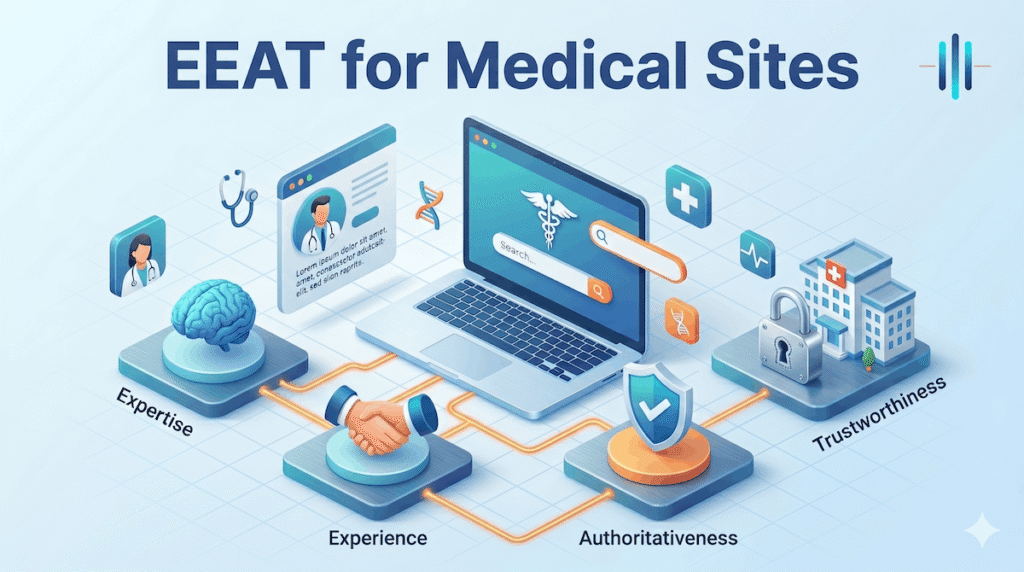
Medical EEAT (Experience, Expertise, Authoritativeness, and Trustworthiness) is how Google verifies the safety of healthcare content. To rank in 2026, practices must move beyond keywords and focus on “Entity” verification. This includes linking physician bio pages to the National Provider Identifier (NPI) database via sameAs schema, using reviewedBy properties for clinical accuracy, and targeting high-intent surgical outcomes instead of broad symptoms.
Medical practices often sink thousands into “SEO content” only to watch their traffic vanish during a Google core update. It’s frustrating. Most medical SEO is theater. You pay for 800-word articles about “the benefits of walking” that no actual patient reads. Google sees right through it. In the eyes of an algorithm, if you can’t prove who wrote the content, it’s a liability.
Google acts like a digital board of ethics for healthcare. If your site doesn’t prove it’s backed by a licensed human, you won’t rank.
EEAT: The Digital Version of Your Medical License
For a local plumber, SEO is about reviews and proximity. For you, it’s about clinical safety. Google uses a framework called EEAT to decide if your advice is worth showing to a human being. Many practices fail because they treat their website like a brochure instead of a verified medical authority.
Think of it this way. You wouldn’t hire a surgeon who couldn’t prove where they did their residency. Google feels the same way about your blog posts.
| Pillar | What Google Seeks | Real-World Medical Equivalent |
|---|---|---|
| Experience | First-hand involvement in the topic. | Your years in the operating room or clinic. |
| Expertise | Professional credentials and specialized knowledge. | Your MD/DO, board certifications, and fellowships. |
| Authoritativeness | Reputation as a primary source in the field. | Citations in journals or hospital board positions. |
| Trustworthiness | Site security, factual accuracy, and transparency. | Your clean record and transparent communication. |
It might feel unfair that an algorithm judges your expertise. But when you consider that 74% of patients now use the internet as their very first step in finding a new doctor, the need for a filter becomes clear. Trust is everything. In fact, data from Software Advice shows that 90% of patients evaluate a provider’s credentials and reviews online before booking. It’s only gotten tougher since the healthcare SEO guide we published earlier.
The High Cost of “Safe” Medical Content
Most agencies sell you “safe” content. They use ghostwriters to churn out generic advice that doesn’t offend anyone. It’s a waste of your budget. Experience requires proof of actual patient care. An AI or a generic writer can’t describe the specific tactile sensation of a successful robotic-assisted surgery. A surgeon can.
When you publish thin content, you aren’t just failing to rank. You’re telling Google that your domain is a source of low-effort information. That label is hard to shake, even if you follow a standard on-page SEO checklist.
The “Entity” Blueprint: Connecting Search to the Operating Room
We don’t just write blogs at Echo & Scale; we build an “Entity” for your practice. This is a technical SEO process that connects your digital presence to real-world government databases.
The NPI Connection
Every doctor in the US has a National Provider Identifier (NPI). It’s your unique fingerprint in the medical world. We use JSON-LD code, which is a key part of using schema for AI visibility, to link your website’s bio page directly to your entry in the official NPI registry. This tells Google’s algorithm that the person writing is a verified, licensed professional. It’s hard to argue with a government database.
The “Medical Reviewer” Loop
You don’t have time to spend four hours writing a blog post. We know that. Our revenue-first SEO model uses a “Reviewer” workflow. We draft the high-intent content based on your specific procedures, and you spend ten minutes verifying the clinical facts. We then use reviewedBy schema to give that content a professional sign-off in the metadata.
Moving Toward Revenue-First Intent
Ranking for “knee pain” is a vanity metric. It brings in window shoppers who are months away from a decision. We want to rank your practice for the terms that indicate someone is ready for a consultation.
We focus on “shoulder” terms through intent-driven keyword research like:
- “What to expect during ACL recovery for athletes”
- “Outpatient vs inpatient hernia repair safety”
- “Pre-surgical clearance requirements for heart patients”
These are the topics that build actual trust. Whether you’re a specialist surgeon or looking at dental SEO, the goal is the same. When a patient finds a clear, expert answer to a specific fear, they book an appointment. You can see how this integrates with a mobile-optimized patient experience on our design page.
FAQs About Medical EEAT
Final Thoughts
The era of gaming the system with keywords is over. If you want to grow your practice in 2026, you have to prove you’re a legitimate medical entity. We’ve seen this change lives for our clients. It moves them from fighting for scraps to being the definitive source of truth in their city.
Check out our advanced SEO strategies for more technical breakdowns, or reach out for a full EEAT audit of your current site.
Book Your Free Call Today
Schedule your Free 20 minute call and get a marketing plan specifically tailored to you.