
- Copy and paste these questions into your agenda to ask in your next meeting
- Why local SEO has become a high-stakes guessing game
- 1. Who owns our digital assets and logins?
- 2. Who is actually working on our account day-to-day?
- 3. What does a real technical audit look like?
- 4. How do you build high-quality local backlinks?
- 5. How does our website adapt to AI search models?
- FAQs for business owners vetting an agency
- Ready to stop guessing?
- Book Your Free Call Today
How to Vet a Local SEO Company Without Getting Burned
By:
Published:
Updated:
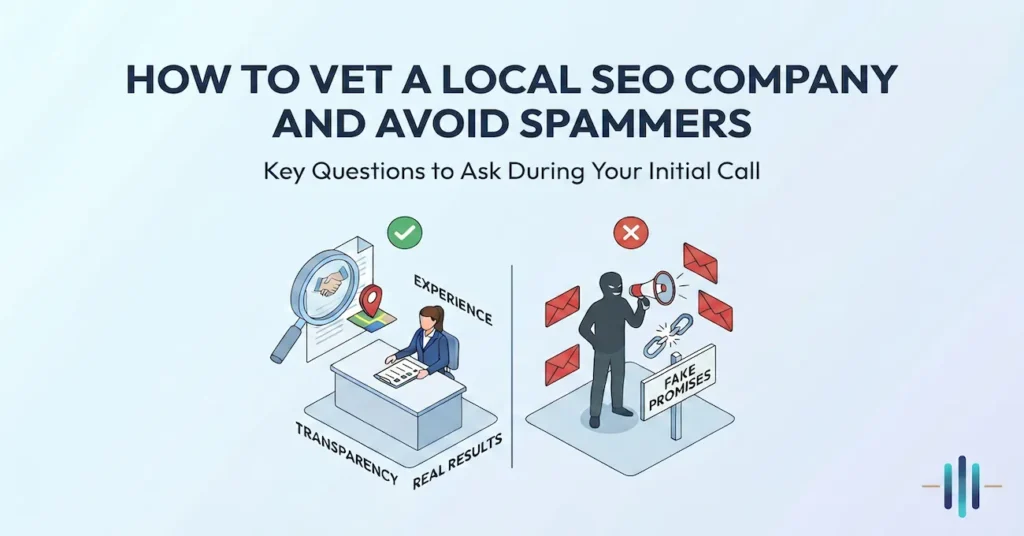
Most local SEO agencies sell automated checklists that look good on paper but do nothing for your bottom line. If you want a partner that actually drives phone calls and revenue, you need to ask the tough, practical questions about account ownership, who is actually doing the work, manual audits, and local link relationships. Use the quick-copy list below to weed out the spammers in your next meeting.
Copy and paste these questions into your agenda to ask in your next meeting
If you are short on time and need to vet an agency today, copy and paste these five questions directly into your interview agenda.
- Will all of our accounts, profiles, and tracking tools be created under logins that I own, and will you grant my team primary admin access from day one?
- Who is actually working on our account on a day to day basis, and will the actual founders or senior strategists be touching my code and content, or is the work done by interns?
- Can you walk me through a manual, high-priority technical issue you found recently, and show me the report you built to fix it?
- What is your realistic strategy for acquiring high-value, local backlinks in our specific county or city, and why do you avoid generic citation packages?
- How do you ensure that our business details are optimized for the latest AI search models so we get recommended directly in answers?
If you want to know what a good answer sounds like, and what red flags to watch out for, read the full breakdowns below.
Why local SEO has become a high-stakes guessing game
Too many times, local agencies package up cheap directory submissions and call it a growth strategy. They promise you visibility, but they ignore whether those impressions turn into actual paying customers.
I constantly talk to business owners who are stuck paying for monthly reports filled with vanity metrics while they aren’t getting any leads. The agency claims they did their job because rankings went up, but if your bank account isn’t growing, that strategy is failing.
If you’re running a business in New Jersey, you already know how fast and crowded our local markets get. There’s no room to burn cash on agencies that don’t produce.
This is exactly where standard checklists falls short of driving real, measurable revenue. We build our entire approach at Echo & Scale on hard numbers and clear UX testing rather than guesswork. If you rely on a generic checklist to stand out, you’re going to lose to the competitor who understands how to really stand out.
1. Who owns our digital assets and logins?
The Question to Ask: Will all of our accounts, profiles, and tracking tools be created under logins that I own, and will you grant my team primary admin access from day one?
🚩 The Red Flag (What a bad or fake answer sounds like): “We set everything up under our master agency accounts to keep things streamlined, but we will send you monthly PDF reports. If you ever decide to leave, we can export your data for a small administrative fee.”
✅ The Green Flag (What a good answer sounds like): “All accounts, from Google Business Profile to Analytics, are registered under your primary corporate email. You grant our team manager-level access, meaning you retain full administrative ownership and can revoke our access at any second.”
One of the most frustrating practices in our industry is when an agency sets up your Google Business Profile, your Google Analytics, or even purchases your domain name under their own master accounts. They hold your digital assets hostage so that it’s nearly impossible for you to leave without losing years of digital authority.
Of course, a lot of difficult SEO agencies do these types of things to force you to rely on them and make it harder to leave. They want to make sure you’re locked into their ecosystem. Sure, it might work for their retention metrics, but we don’t work like that.
The Echo & Scale Way
A part of Echo & Scale’s philosophy is that we make sure you own everything from the start. We’ll have an onboarding call with our clients before any work is done to talk about what tools we use, what tools they have, and ask what they’re most comfortable with. We also ensure the tools we use have some sort of Admin level with a transfer owner option to make sure that if this does ever happen, we don’t stand in the way of your business.
Any client-agency relationship is always built on respect and mutual agreement because this is a partnership, not a money pit. We’re not here to milk you for every dollar. We want to provide a seamless and positive experience for our clients at every step. Even if that’s during offboarding.
My advice to business owners is to have a blunt and uncomfortable conversation with your agency and tell them you want to have full ownership of your tools. They must add you as an admin so when you decide to work with us, you can add us to the platform. You can learn more about how we handle these active assets on our Local SEO Best Practices Guide.
2. Who is actually working on our account day-to-day?
The Question to Ask: Who is actually working on our account on a day to day basis, and will the actual founders or senior strategists be touching my code and content, or is the work done by interns?
🚩 The Red Flag (What a bad or fake answer sounds like): “Our accounts are supervised by senior strategists, but day-to-day updates and content creation are managed by our capable junior associates and interns.”
✅ The Green Flag (What a good answer sounds like): “You will work directly with our founders from day one. We do not hire junior interns or outsource client work. The senior experts who pitch your strategy are the ones writing your content and touching your code.”
It’s a classic bait-and-switch. A large agency uses their senior executive team to win your business, but then hands your account over to a junior intern managing dozens of other clients. You get pitched by a partner with decades of experience, but your actual daily strategy is run by someone who graduated college last month.
The Echo & Scale Way
Because we’re a small team, you get fully dedicated attention by the founders of Echo & Scale from the start. We have a combined ~25 years of experience across design, psychology, and technical SEO. From day one, you will always be in contact with the founders. There are no interns or outsourced work. Everything is done in-house by us.
When you work with a partner where the founders are directly touching your code and content, you aren’t just a line item on a spreadsheet. You get senior-level execution that actually moves the needle. You can see how this direct attention informs our entire approach on our Echo & Scale Process page.
3. What does a real technical audit look like?
The Question to Ask: Can you walk me through a manual, high-priority technical issue you found recently, and show me the report you built to fix it?
🚩 The Red Flag (What a bad or fake answer sounds like): “We run your site through our proprietary auditing software at the start of each month and deliver a comprehensive 50-page PDF report showing all of your errors and warnings.”
✅ The Green Flag (What a good answer sounds like): “We perform a manual audit using configured crawls. We analyze crawl sheets line-by-line for issues like response codes, canonical directives, and mobile sitemaps, then build a prioritized fix report with impact and why this fix matters for your site.”
The market is flooded with “free website audit” offers. Cheap agencies simply plug your URL into a generic, automated tool like a standard SEMrush or Ubersuggest export, slap their logo on a 50-page PDF, and call it a custom audit. That isn’t actual auditing. It is just software output.
The Echo & Scale Way
At Echo & Scale, we’ve done several technical site audits ranging from really in the weeds audits to high level tactics. I do a few things at the start. I make sure my ScreamingFrog is configured for the crawl and run a crawl of the entire site. I export all the reports I need from ScreamingFrog including response codes, orphan urls, sitemap, h1s, title, meta descriptions, canonicals, image details, and directives, making sure everything looks good.
Then I’ll read through and analyze the information in the sheets for each export and see where the client needs work and what they’re doing well. But I don’t just look at spreadsheets the whole time. I’ll manually navigate through their website, writing down notes as I go through with what I observe. Things like if the site is optimized for mobile screens, internal links are working and pointing to where they need to be going, anchor text, blog pages, and site layout. I also will use Chrome Extensions like Detailed to confirm the ScreamingFrog findings. I’ll also make sure they have valid tracking tags for analytics tools like Google Search Console and Google Analytics.
Finally, I’ll put together a report with all the findings, why they’re important to fix, how we recommend fixing them, and their impact. That is what a real Technical SEO audit looks like.
Here is an example of a very high-level technical audit we did for a client:
| SEO Foundation | Finding | Recommendation | Why this matters |
|---|---|---|---|
| On-Page | Poor heading structure (H1, H2, H3, etc) | One clear H1 per pageUse H2s/H3s for sections beneath it Align headings to actual keywords and page intent | This makes it harder for search engines to understand page focus and page structure. Giving search engines a clear structure improves understanding and crawlability of pages |
| On-Page | A number of key pages have short or missing SEO metadata. | Rewrite page titles around real search intent rather than just [treatment] | [site title] Add unique meta descriptions to all core pages Fix broken auto-generated blog metadata | Titles and meta descriptions help Google understand what the page is about better and influence click-through rate by making them interesting to readers. Right now, many pages are under optimized or low-quality. |
| On-Page | Homepage targeting is too narrow / mismatched:“Premium NAD+ IV Therapy | Boost Health & Vitality” | Reposition homepage SEO around the main business category, not just one treatment Example angle: “Mobile IV Therapy & Wellness Infusions in Long Island | Health Infusion Services” | If the homepage is optimized mainly around NAD+, it may be limiting broader rankings for other key service and local terms |
| Technical SEO | No Schema Markup used | LocalBusiness / MedicalBusiness schema Organization schema Service schema FAQ schema where relevant Breadcrumb schema | For a local healthcare/wellness business, schema helps Google & AI understand and reinforce your content. |
| Local SEO | Branded search signals look weak. Search results did not show a strong, well-established footprint. | Strengthen local SEO signals by: Improve Google Business Profile presence Earn real reviews by sending follow ups Build backlinks from local directories Create targeted service/location pages Ensure NAP is consistent throughout the site and profiles | This usually means limited authority, weak brand signals, and likely low organic visibility overall. |
4. How do you build high-quality local backlinks?
The Question to Ask: What is your realistic strategy for acquiring high-value, local backlinks in our specific county or city, and why do you avoid generic citation packages?
🚩 The Red Flag (What a bad or fake answer sounds like): “We guarantee 200+ local citation submissions across high-authority directories within your first 30 days to maximize your map coverage.”
✅ The Green Flag (What a good answer sounds like): “We avoid generic citation packages because Google flags bulk automated listings as spam. Instead, we target contextual local links via city-specific directories, regional partnerships, and high-value, linkable content.”
I avoid the agencies promising “200 citation submissions” as a primary strategy. These are low-quality, paid links that can do more harm than good in the long run. In fact, Google’s official link spam policies explicitly state that automated or low-quality link building techniques can be flagged as spam when abused.
That doesn’t mean having your site listed on local directories is useless. Foundational directory listings are helpful because they show search engines you are an active local business and a verified part of your community. According to Moz’s Local Search Ranking Factors study, Google Business Profile optimizations make up roughly 32% of Local Pack ranking signals, while on-page consistency and quality local link signals drive another 25% of your search presence. Citations are a part of that foundation, but they shouldn’t be the core of your backlink strategy.
Think of backlinks like real-world referrals. If a trusted neighbor recommends a local contractor, you are far more likely to hire them because of that human recommendation. Backlinks work the exact same way online. A link from a trusted, relevant local site acts as a powerful vote of confidence in the eyes of search algorithms.
The Echo & Scale Way
At Echo & Scale, we don’t make promises about how many backlinks we’ll get. We set a goal, we tell you our realistic targets, and we’ll work with you on achieving them to get you the most relevant and high quality backlinks to your website. We strive for quality backlinks through guest posting on relevant blogs, linking to local directories in your county and city, and producing highly linkable content that will naturally get linked to just from the value they provide. You can read more about how we align content with intent in our Intent-Driven Keyword Research Guide. For a step-by-step breakdown of how search engines crawl and evaluate regional sites, check out Ahrefs’ Local SEO Guide.
5. How does our website adapt to AI search models?
The Question to Ask: How do you ensure that our business details are optimized for the latest AI search models so we get recommended directly in answers?
🚩 The Red Flag (What a bad or fake answer sounds like): “AI search is too new to target. We focus on standard Google and Bing organic keyword rankings instead.”
✅ The Green Flag (What a good answer sounds like): “We structure your local data using precise schema markup and verify your entity profile across trusted directories so AI models can easily crawl, verify, and cite your business in direct answers.”
As search behavior is shifting toward AI answers, the questions you ask your agency should also look ahead. You can’t rely on tactics from five years ago. You need to ensure your data is structured for bots to easily scrape and cite your website.
The Echo & Scale Way
To stand out in AI answers, you need a partner who understands how to build search engine trust through schema markup and entity verification. We broke down exactly how to format your code for this in our guide on Using Schema for AI Visibility.
FAQs for business owners vetting an agency
Ready to stop guessing?
If you are tired of monthly reports that show great impressions but zero new phone calls, your foundation needs work. Let’s discuss a manual technical audit that actually moves the needle for your business. Explore our Revenue-Driven SEO Agency solutions to start growing your local presence today.
Book Your Free Call Today
Schedule your Free 20 minute call and get a marketing plan specifically tailored to you.