
- Why most dental offices are chasing the wrong numbers
- Why does search intent matter more than raw traffic volume?
- How do we find the "hidden" keywords that standard tools miss?
- Why is Schema markup actually the credentials of your digital presence?
- How can a strategic blog act as an authority engine for your practice?
- Where does the agency's work end and your staff's job begin?
- What does Dental SEO ROI actually look like?
- FAQs About Dental SEO
- Book Your Free Call Today
The ROI of Dental SEO: Why Search Intent Beats Search Volume Every Time
By:
Published:
Updated:
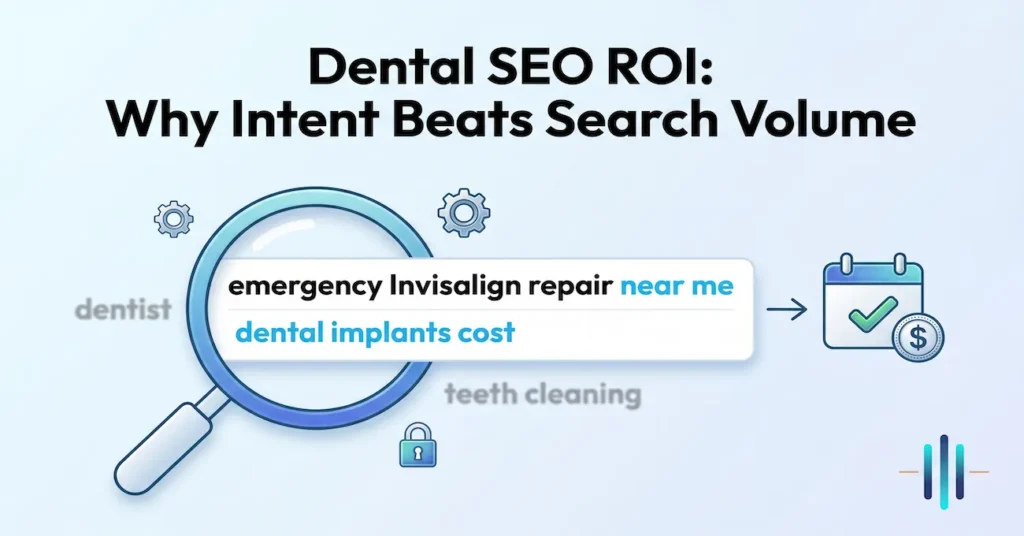
Traffic has become a vanity metric in 2026. If your dental practice is getting clicks but no bookings, you have an intent problem. This guide explains how targeting zero-volume keywords, implementing technical Schema, and building a clinical EEAT engine through blogging creates a sustainable ROI that broad SEO can’t match.
Why most dental offices are chasing the wrong numbers
Imagine you’re shopping for new fragrances. You walk up to the counter and tell the clerk you want “fragrances.”
They’ll probably look at you with a mix of confusion and pity before handing you fifty different bottles. Fresh, woody, musky, citrus—most of which you’ll hate. Now, compare that to walking up and saying, “I want a fresh, subtle scent that isn’t too strong for a professional office setting.”
Suddenly, you have two options. Both are exactly what you need.
Most SEO agencies sell “traffic” the same way that clerk sells “fragrances.” They promise you a crowd, but they don’t care if that crowd is actually looking for a dentist. This broad approach is why so many practices feel like SEO is a black hole for their marketing budget. You might be getting clicks, but if they aren’t turning into seated patients, you’re just paying for someone else’s data.
While these principles apply across the entire healthcare SEO landscape, they are particularly brutal in the dental world where competition is hyper-local and margins depend on specific high-value procedures.
Why does search intent matter more than raw traffic volume?
There is a massive difference between Search Volume and Revenue Proximity.
Most tools will tell you that the term “dentist” has thousands of searches a month. It sounds impressive in a monthly report. But the search intent for “dentist” is incredibly vague. It could be a student doing a project, a salesperson looking for leads, or someone just checking office hours for a place they already visit.
Contrast that with a Zero Volume keyword like “emergency Invisalign tray repair near me.”
No SEO tool is going to tell you that term has massive traffic. In fact, most will say it has zero. But the person typing that into Google at 2 AM has a high-intent, high-margin problem that needs a solution immediately. That is a revenue project, not a vanity project.
Our SEO services prioritize these high-intent clusters—Invisalign, implants, and emergency care—because they move the needle on your bottom line faster than ranking for broad terms ever will.
| Search Term | Intent Type | Booking Likelihood |
|---|---|---|
| “Dentist near me” | Navigational / Broad | Low to Medium |
| “What is a dental implant” | Informational | Low |
| “Affordable dental implants [City]” | Commercial Investigation | High |
| “Emergency dental implant repair” | Transactional | Very High |
How do we find the “hidden” keywords that standard tools miss?
If you only rely on SEMrush or Ahrefs, you’re seeing the same data as every other dentist in your zip code. To win, you have to look where the tools aren’t.
We start by auditing your site to identify your most profitable services. Once we know what actually drives your revenue, we stop looking at keyword databases and start looking at Google itself.
By mining the “People Also Ask” (PAA) boxes and Google Autofill, we can see the exact, long-tail questions your patients are typing. These are the hidden keyword—specific problems that Google knows people are searching for, even if the marketing tools haven’t caught up yet. Answering these questions clearly makes you the immediate authority in the eyes of both the patient and the algorithm.
This is the core of intent-driven keyword research: being the answer to the specific problem, not just another link in a list.
Why is Schema markup actually the credentials of your digital presence?
If your website is your digital storefront, Schema markup is the board-certified diploma hanging on your wall.

One of the biggest mistakes we see in dental SEO is a complete lack of structured data. Schema is a specialized code that tells search engine crawlers exactly who you are, where you are, and what credentials you hold. It isn’t just about “helping” Google; it’s about providing the technical proof of your expertise.
Without it, you’re forcing a crawler to guess. With it, you’re signaling your location, your reviews, and your services in a language the AI understands perfectly. For a deeper look at how this builds trust, check out our technical SEO guide.
How can a strategic blog act as an authority engine for your practice?
A blog shouldn’t be a place for office news or pictures of the staff Christmas party. It should be an authority engine.
In the medical world, Google’s quality filters are exceptionally high. They look for EEAT (Experience, Expertise, Authoritativeness, and Trustworthiness). A blog allows you to demonstrate this expertise by answering complex patient concerns in detail.
It serves two purposes:
1. It signals to Google that your practice is a clinical authority.
2. It acts as the “net” that catches all those high-intent, long-tail questions we found earlier.
By following a clear medical EEAT strategy, your blog becomes a tool for patient acquisition rather than just a hobby. Every post should be optimized using a rigorous on-page SEO checklist to ensure it’s actually being found by the people who need it.
Where does the agency’s work end and your staff’s job begin?
SEO is a partnership built on trust.
As your agency, our responsibility is to drive the highest-quality organic traffic possible to your site. But we can’t be in the room when you’re treating a patient. This is where the trust loop comes in.
We trust that you will provide an exceptional patient experience. You trust that we will keep your digital pipeline full. When you provide that great experience, it naturally leads to the 5-star reviews that act as a primary ranking factor for local search.
This transparency is a core part of the Echo & Scale process. We don’t just send you reports; we work with you to ensure the patient in the chair is the metric that’s growing.
What does Dental SEO ROI actually look like?
If you’re looking for a reason to pivot your budget, look at the benchmarks from the industry’s most reputable sources. According to data aggregated by SEMRush, businesses that successfully rank in the “Local Map Pack” (the top 3 results) receive 126% more traffic and 93% more direct actions like phone calls and booking requests compared to those ranked just a few spots lower.
Furthermore, Search Engine Journal reports that about 46% of all Google searches now have local intent. For a dental practice, this means nearly half of all search activity is a direct opportunity to capture a patient in your immediate area who is ready to book.
FAQs About Dental SEO
Book Your Free Call Today
Schedule your Free 20 minute call and get a marketing plan specifically tailored to you.