
Local Business Schema for Multi-Location Startups: A Technical Rollout Guide
By:
Published:
Updated:
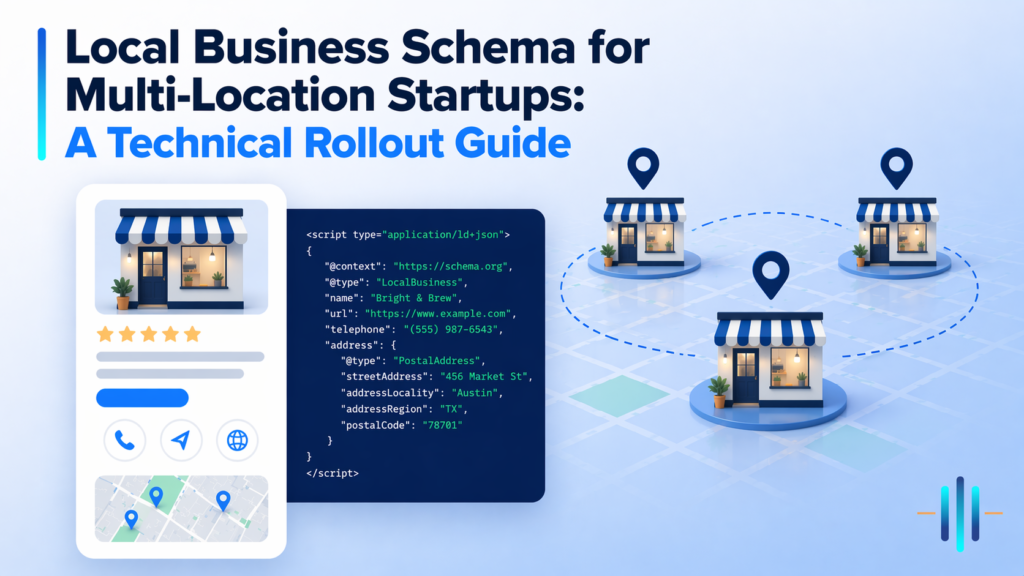
Scaling a startup with several locations? You can’t just copy and paste the same code everywhere, it’s essential to use multi location schema markup. You need a Parent-Child JSON-LD structure. Define your main brand using Organization schema on your homepage. Then, create unique LocalBusiness markup for every individual location page. Each branch needs its own @id, physical address, and geo-coordinates. This creates a clear data map that AI engines like Gemini and ChatGPT use to verify your business footprint.
Scaling a business is exciting until your digital presence starts to break. If you’ve just opened your third or fourth office in a place like Old Bridge, you’ve probably noticed Google getting a bit confused. One day you’re ranking for your brand in Jersey City, and the next, your Old Bridge branch is nowhere to be found on the map. It happens fast. Usually, the marketing team is so focused on getting the doors open that the technical data on the backend gets ignored. You might have a beautiful website, but if your data signals are conflicting, you’re invisible to the people who want to hire you.
I’ve seen this often. A company expands and just copies the homepage schema to every new location page. They wonder why their Old Bridge office doesn’t show up in the local map pack. It’s because Google is confused. If you tell a search engine that three different addresses are all the primary headquarters, it stops trusting all of them. It’s a bit of a headache, honestly.
Clarity is your best asset. AI Overviews and traditional search results now rely heavily on “entity authority.” You’re no longer just trying to rank for a keyword. You’re trying to prove to a machine that your business exists in a specific place at a specific time. This is why our SEO services focus so heavily on the technical foundation before we even think about writing a blog post.
Why Data Consensus is the New Local SEO Baseline
Search has changed. It isn’t just about having the right words on the page anymore. When someone asks an AI assistant for “the best marketing agency in Central Jersey,” the model looks for verified facts. It checks multiple sources to see if your address, phone number, and services match up.
Industry research from the Whitespark Local Search Ranking Factors Survey shows that on-page signals account for 36% of local organic ranking factors. While the “Local Pack” (the map) is heavily influenced by your Google Business Profile, your website’s technical health is what provides the authority those maps need to function. That’s a huge chunk of your visibility. If you have one office in Jersey City and another in Old Bridge, the search engine needs to see the connection between them. You need to show that these branches belong to one main brand. This is a big part of how you build schema for AI visibility, ensuring that chatbots don’t just know who you are, but where you actually operate.
When your data is messy, AI engines tend to make things up or simply ignore your brand. They prefer sources they can verify against other data points. If your website says one thing and your Google Business Profile says another, you lose the trust of the algorithm. This is why we focus so much on technical precision. It isn’t just for Google anymore; it’s for every large language model that might recommend your business to a potential client.
The Parent-Child Implementation Framework
Think of your brand data as a logical hierarchy. Your homepage is the primary source. Your location pages are the specific extensions. You don’t give the primary corporate tax ID to the individual branch for local filings. The same logic applies to your code.
1. Defining the Brand Entity (Organization Schema)
Your homepage is your “Source of Truth.” This is where you put your global brand data. You tell the world about your logo, your main website, and your social profiles using the sameAs property. This is the only place where the broad Organization schema should live. For more on the fundamentals, check out our Technical SEO Guide for Small Businesses.
2. Creating Unique Location IDs
This is where most startups fail. On your location page for your Old Bridge, NJ branch, you need LocalBusiness schema. But you should go a step further. Use a specific sub-type like ProfessionalService or ConsultingInterface if it fits.
Every location needs a unique @id URL. This is a technical requirement that tells AI, “this specific branch is a distinct entity.” It prevents “entity collision,” which is what happens when Google thinks your different offices are just duplicates of the same page.
| Schema Property | Why It Matters for Your Startup |
|---|---|
@id | A unique identifier that tells AI this branch is distinct. |
parentOrganization | Connects the branch back to your main brand. |
geo | Latitude and longitude. This is vital for “near me” voice searches. |
areaServed | Defines the specific towns you cover, like Sayreville or Marlboro. |
3. Mapping Relationships
If your startup is complex, you can use the department property. Maybe you have a sales office and a warehouse in the same building in Old Bridge. The department tag tells the search engine that there are two different functions happening at one address. It adds a layer of detail that helps you show up for more specific searches. This level of granularity is what separates a professional SEO setup from a basic one.
Technical Checklist for Scaling in the Tristate Area
If you’re operating across New Jersey, New York, and Pennsylvania, your data must be perfect. The competition here is too high to be lazy with your code. Every detail matters when you’re trying to win in a crowded market like Hudson County or Manhattan.
- Use JSON-LD Only: Don’t use Microdata or RDFa. Google and modern AI models prefer JSON-LD because it’s easier to read and less likely to break your site design. It keeps your code separated from your HTML.
- Verify Your NAP: Your Name, Address, and Phone number in the code must match your Google Business Profile exactly. Even a small difference like “St.” versus “Street” can cause issues with how search engines group your data.
- Provide Geo-Coordinates: Don’t just give a zip code. Give the exact latitude and longitude. This helps in crowded areas like Old Bridge where businesses are packed close together. It gives the search engine a precise point on a map.
- Connect Social Profiles: Link your branch-specific Yelp or LinkedIn pages directly in that location’s schema. This builds a “web of trust” for your brand and helps AI engines find more evidence that your branch is legitimate.
JSON-LD Example: The Old Bridge Branch
Here is how the code should look for a branch office to make the relationship clear to any search engine. We’ve used Old Bridge as the specific location entity here:
{
  "@context": "https://schema.org",
  "@type": "ProfessionalService",
  "@id": "https://echoandscale.com/locations/old-bridge-nj/#branch",
  "name": "Echo & Scale - Old Bridge",
  "image": "https://echoandscale.com/images/old-bridge-office.jpg",
  "telePhone": "732-555-0199",
  "url": "https://echoandscale.com/locations/old-bridge-nj",
  "parentOrganization": {
    "@type": "Organization",
    "name": "Echo & Scale LLC",
    "url": "https://echoandscale.com"
  },
  "address": {
    "@type": "PostalAddress",
    "streetAddress": "123 Route 9 North",
    "addressLocality": "Old Bridge",
    "addressRegion": "NJ",
    "postalCode": "08857",
    "addressCountry": "US"
  },
  "geo": {
    "@type": "GeoCoordinates",
    "latitude": "40.4284",
    "longitude": "-74.3000"
  }
}
Checking Your Work
After you add the code, don’t just assume it works. Use the Schema Markup Validator. It’ll tell you if you have a missing comma or a broken bracket. You should also use the Rich Results Test from Google. If your data isn’t “eligible” for rich results, an AI model will likely ignore it.
I’ve found that startups that fix this technical debt early on grow much faster. They see an average 27% increase in organic traffic compared to those that wait. It’s much easier to build a clean foundation now than it is to fix a broken one when you have ten offices. If you’re looking for a quick sanity check, run through our On-Page SEO Checklist.
Think of your schema as a continuous project. As you add services or move people between offices, your data needs to reflect those changes. If you hire a new lead strategist for your Old Bridge office, you might even consider adding employee schema to that specific location. This helps humanize your brand and gives the search engine even more “entities” to connect to your business.
FAQ: Questions About Multi-Location SEO
Final Thoughts
Building a startup is difficult enough without fighting your own data. By using a clean, professional schema structure, you aren’t just checking an SEO box. You’re building a map for the future of search. This is part of the shift from traditional SEO to GEO, and it’s something every growing brand needs to understand if they want to survive the next few years of search changes.
If the technical side of scaling feels like too much, we can help. At Echo & Scale, we build revenue-first marketing plans for growing businesses in NJ and PA. We handle the code so you can focus on running your business. We know the local market because we live here.
Want to see if your current setup is working? Contact us today for a quick technical review of your site.
Book Your Free Call Today
Schedule your Free 20 minute call and get a marketing plan specifically tailored to you.